Why Connected Worker Technology is the Fastest Growing Segment in Industrial Safety
Introduction
Why Leading Companies Choose Connected Safety
Industrial safety is undergoing a fundamental transformation. After decades of incremental improvements in traditional safety equipment and training methods, we're witnessing rapid adoption of connected worker technology that fundamentally changes how companies protect their employees.
Let’s explore how Safety requires a personal touch. New technology allows safety professionals to scale their impact and effectiveness without compromising their ability to connect with workers.
The Safety Technology Revolution is Here
The numbers tell a compelling story: the market for wearable safety technology in construction and industrial operations is experiencing double-digit annual growth, driven by measurable improvements in worker protection, operational efficiency, and regulatory compliance. Industry analysts project this market will grow from over $4 billion in 2024 to nearly $7 billion by 2029—a compound annual growth rate exceeding 10%.
But this isn’t growth for growth’s sake. Companies are investing in connected worker solutions because they deliver tangible results that traditional safety approaches cannot match. Understanding why this technology is gaining traction—and what separates effective solutions from gimmicks—is essential for safety leaders evaluating their options.
The Five Forces Driving Connected Worker Technology Adoption
1. Rising Incident Rates Demand Better Solutions
Despite ongoing safety investments, workplace incidents continue to rise in many industrial sectors. Recent data shows fatal work injuries increased by nearly 6% in a single year, with construction, manufacturing, and logistics experiencing disproportionate shares of serious incidents.
These statistics reflect a harsh reality: traditional safety programs have hit a ceiling. Training, PPE, and supervision remain essential, but they can’t address the fundamental challenge of providing real-time visibility and intervention capability across large, complex work environments.
Connected worker technology breaks through this ceiling by enabling:
- Continuous monitoring instead of periodic observation
- Immediate intervention instead of post-incident investigation
- Objective data instead of subjective assessments
- Predictive analytics instead of reactive responses
2. Labor Shortages Require Technology Multiplication of Safety Resources
Many industries face critical labor shortages, including experienced safety professionals. Companies need to do more with fewer people, which means safety teams must leverage technology to multiply their effectiveness.
A single safety manager cannot physically observe hundreds of workers spread across multiple zones, shifts, and locations. But connected worker systems enable that same safety manager to:
- Monitor all workers simultaneously through real-time location tracking
- Receive intelligent alerts prioritizing where attention is needed most
- Identify patterns and trends impossible to detect through manual observation
- Document safety performance objectively for coaching and compliance
This isn’t about replacing human judgment—it’s about amplifying human capability so safety professionals can focus their expertise where it matters most.
3. Remote Work and Distributed Operations Need Remote Monitoring
The nature of industrial work has changed. Projects span larger geographic areas, workers operate in more isolated conditions, and management teams oversee operations they cannot physically visit daily. This dispersion creates safety blind spots that traditional supervision cannot address.
Remote monitoring capabilities enable safety management across distributed operations:
- Multi-site visibility: Safety directors can monitor multiple facilities from a central operations center
- Lone worker protection: Automated check-ins and location tracking for isolated workers
- Virtual supervision: Real-time alerts enable intervention even when physical presence isn’t possible
- Consistent standards: Same monitoring parameters apply across all locations regardless of distance
4. Digital Transformation of Industrial Operations
Construction sites, manufacturing facilities, and logistics operations are becoming increasingly digital. Building Information Modeling (BIM), IoT sensors, automated equipment, and data analytics are standard components of modern operations.
Connected worker technology integrates naturally into these digital ecosystems, providing the “people layer” that complements physical asset monitoring:
- Worker location data integrated with equipment tracking systems
- Personnel safety metrics incorporated into operational dashboards
- Incident data feeding continuous improvement analytics
- Compliance documentation automated through system integration
5. Regulatory Pressure and Liability Concerns
Regulatory requirements continue to expand, with agencies developing more stringent safety standards and enforcement becoming more aggressive. Companies face both regulatory penalties and civil liability for safety failures.
Connected worker systems help companies demonstrate due diligence:
- Documented compliance: Objective records of safety procedures being followed
- Training verification: Proof that only qualified workers accessed high-risk areas
- Incident evidence: Complete data about conditions before, during, and after incidents
- Continuous improvement: Demonstrated use of data to refine safety programs
Why LoRaWAN is Winning in Industrial Environments
Not all connected worker technologies are created equal. While various approaches exist—Wi-Fi based systems, cellular solutions, Bluetooth-only designs—LoRaWAN (Long Range Wide Area Network) technology has emerged as the preferred architecture for industrial applications.
The reasons are both technical and practical:
Superior Coverage with Minimal Infrastructure
Industrial facilities often span large areas with challenging RF environments: metal structures, thick walls, outdoor and indoor zones, and electromagnetic interference from equipment. LoRaWAN’s long-range, low-power characteristics enable:
- Coverage of 10-15 km in open areas and several kilometers in industrial settings with a single gateway
- Penetration through buildings and structures that block Wi-Fi and cellular signals
- Fewer access points required compared to Wi-Fi systems, reducing installation costs and complexity
- Flexible deployment using existing structures without extensive electrical work
A typical construction site requiring 20-30 Wi-Fi access points for complete coverage might need only 3-5 LoRaWAN gateways—dramatically reducing infrastructure costs and setup time.
Reliable Performance in Harsh Conditions
Industrial environments are hostile to technology: extreme temperatures, moisture, vibration, dust, and physical impacts. LoRaWAN devices are designed for these conditions:
- Battery life measured in months or years, not hours or days
- Weather-resistant operation from -40°C to +85°C
- Robust protocols that maintain connectivity despite interference
- Simple, rugged form factors requiring no user interaction
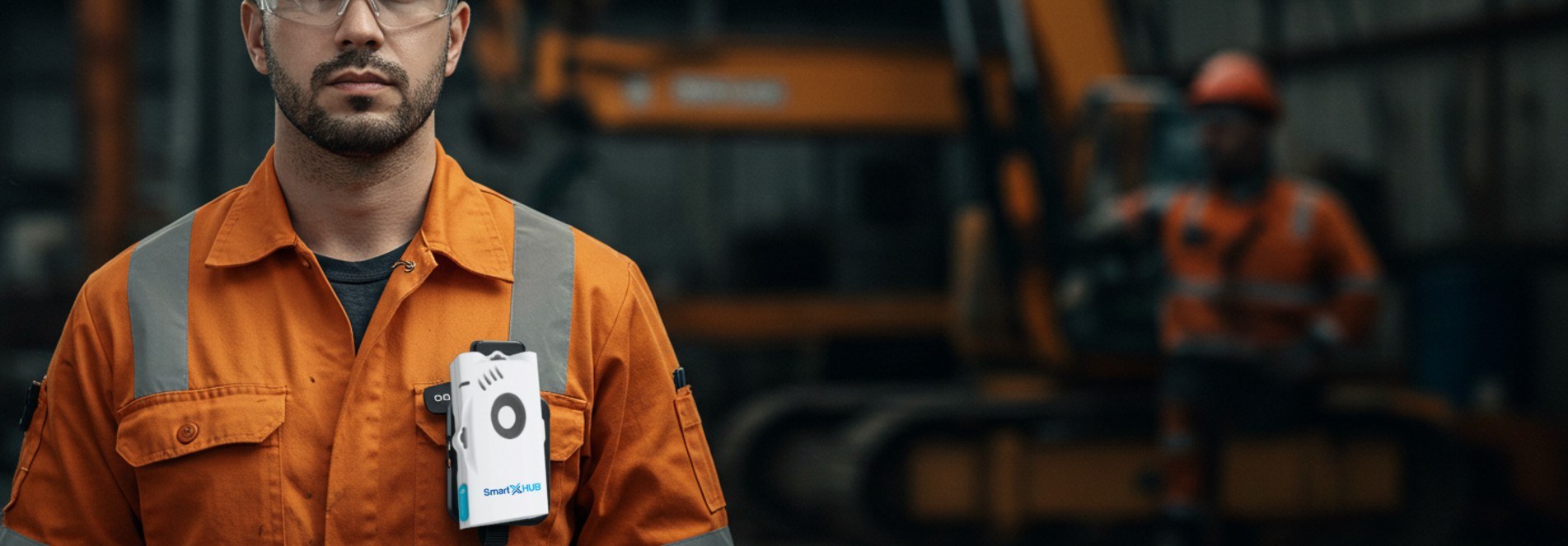
Workers can attach a Smart Badge to their hard hat or safety vest and forget about it—no apps to open, no charging stations to remember, no delicate screens to protect.
Scalability for Growing Operations
LoRaWAN networks scale effortlessly as operations expand:
- Add more workers by simply deploying additional badges
- Extend coverage by adding gateways without complex network configuration
- Integrate new sensors and devices into the same infrastructure
- Support thousands of devices on a single network without performance degradation
This scalability means companies can start with pilot programs in high-risk areas and expand based on results, rather than requiring massive upfront investments.
Data Security and Privacy
Industrial operations have legitimate concerns about data security, especially when worker location information is involved. LoRaWAN’s architecture provides inherent security advantages:
- End-to-end encryption at the network protocol level
- Private network options that keep data entirely within company infrastructure
- No dependency on public cellular networks or internet connectivity for core functionality
- Granular access controls determining who can see what data
Smart PPE: The Next Evolution Beyond Basic Tracking
While location tracking forms the foundation of connected worker systems, leading-edge solutions integrate additional capabilities that transform simple tracking into comprehensive worker protection.
Environmental Monitoring
Smart badges can incorporate sensors detecting environmental hazards:
- Temperature and humidity for heat stress prevention
- Gas detection for toxic atmosphere exposure
- Noise levels for hearing protection compliance
- Impact detection for fall or collision events
These sensors create a complete picture of worker exposure, enabling both immediate intervention and long-term trend analysis.
Biometric Monitoring
More advanced systems integrate physiological monitoring:
- Heart rate and heart rate variability indicating stress or fatigue
- Core body temperature for heat illness prevention
- Movement patterns suggesting exhaustion or impairment
- Posture analysis for ergonomic risk management
This biometric data enables predictive intervention before workers reach dangerous states, rather than responding after symptoms become obvious.
Two-Way Communication
Connected worker systems increasingly include communication capabilities:
- Emergency alerts workers can trigger when in distress
- Safety reminders sent to workers entering high-risk zones
- Evacuation instructions during emergencies
- Check-in requirements for lone workers or confined space entry
The SmartX Safety Approach: Practical, Scalable, Proven
SmartX Safety has built our connected worker platform specifically for the realities of construction, manufacturing, mining, and logistics operations. Our approach prioritizes:
Rapid Deployment
Most sites become operational within 3-5 days:
- LoRaWAN gateways mount on existing structures
- Smart Badges require no configuration—just distribute and activate
- Web-based dashboard accessible immediately
- Minimal training required for supervisors and workers
Worker Acceptance
Technology only works if workers actually use it:
- Clip-on badges that require zero user interaction
- No apps to download or remember to open
- No charging stations or battery management
- Rugged design that survives real-world conditions
Integration Flexibility
Connected worker data becomes more valuable when combined with other systems:
- Export to existing safety management platforms
- Integration with access control and time tracking
- API connectivity to custom applications
- Standard data formats for analytics tools
Measurable ROI
Our clients track tangible benefits:
- Reduced incident rates through early intervention
- Lower workers’ compensation costs
- Faster emergency response and mustering
- Improved safety audit and compliance documentation
- Enhanced productivity through optimized workflows
Real-World Applications Across Industries
Construction Sites
- Fall protection verification: Ensure workers at elevation have proper training
- Confined space management: Monitor entry/exit and verify rescue readiness
- Heat stress prevention: Track exposure in high-temperature zones
- Equipment proximity alerts: Prevent pedestrian-vehicle conflicts
Manufacturing Facilities
- Machine safeguarding: Verify lockout/tagout procedures being followed
- Hazardous material zones: Control access to areas requiring special training
- Emergency mustering: Account for all personnel during evacuations
- Ergonomic risk management: Identify workers with excessive repetitive strain exposure
Mining Operations
- Underground worker tracking: Always know who is underground and where
- Atmospheric monitoring integration: Combine location with gas detection
- Evacuation management: Guide workers to safety during emergencies
- Isolated worker protection: Automated check-ins for lone workers
Logistics and Warehousing
- Forklift interaction zones: Alert when pedestrians enter vehicle traffic areas
- Loading dock safety: Monitor high-activity zones for compliance
- Temperature-controlled areas: Limit exposure time in extreme cold
- Contractor management: Track and control third-party personnel
Beyond Technology: Building a Culture of Connected Safety
The most successful connected worker implementations share a common characteristic: they use technology to enhance culture, not replace it.
Technology enables conversations—not accusations. When a supervisor receives an alert that a worker entered a high-risk zone without proper certification, it creates an opportunity for a coaching conversation based on objective data rather than assumptions.
Data reveals patterns—not just incidents. Analyzing weeks or months of location and behavior data reveals risk patterns invisible to human observation, enabling targeted improvements before incidents occur.
Automation handles routine monitoring—freeing humans for relationship building. Safety professionals spend less time on routine compliance checks and more time building trust, mentoring workers, and solving complex problems.
Visibility creates accountability—for everyone. Workers know their safety practices are monitored. Management knows their safety systems are being measured. This mutual accountability drives continuous improvement.
The Future is Already Here
The rapid growth of connected worker technology isn’t speculation about the future—it’s documentation of the present. Forward-thinking companies across construction, manufacturing, mining, and logistics have already deployed these systems and are seeing measurable results.
The question isn’t whether connected worker technology will become standard in industrial operations—it’s whether your organization will be an early adopter that gains competitive advantage, or a late follower playing catch-up while competitors demonstrate superior safety performance.

Taking the First Step
Implementing connected worker technology doesn’t require ripping out existing safety programs or making massive infrastructure investments. The most successful approaches start small and scale based on results:
- Identify highest-risk areas or operations where real-time visibility would prevent the most serious incidents
- Deploy pilot program with limited scope to demonstrate value and refine implementation
- Measure results objectively comparing incident rates, near-misses, and response times before and after
- Expand based on proven ROI to additional areas, facilities, or capabilities
- Integrate with existing systems to maximize value from combined data
SmartX Safety specializes in helping companies navigate this journey, from initial assessment through full-scale deployment and optimization.
Ready to Join the Connected Worker Revolution?
If your organization is ready to move beyond traditional safety limitations and implement technology-enhanced worker protection, SmartX Safety can help.
Contact us to:
- Discuss your specific safety challenges and operational environment
- See demonstrations of connected worker technology in action
- Review case studies from similar operations
- Develop a pilot program tailored to your highest-priority needs
- Understand the complete ROI picture including reduced incidents, improved compliance, and operational benefits
The connected worker technology market is growing rapidly because it works. Companies that deploy these systems see measurable improvements in worker safety, operational efficiency, and regulatory compliance. Don’t wait for the next serious incident to reveal gaps in your safety program—take proactive steps today.
Combining for Workplace Safety and Optimization AI and a Connected Workforce for Workplace Safety and Optimization with Smartx HUB
SmartX Safety provides intelligent personnel tracking and safety monitoring solutions for industrial facilities worldwide. Our LoRaWAN and BLE-based platforms help companies protect workers, improve operational efficiency, and maintain compliance in challenging environments, including manufacturing, mining, construction, and logistics operations.
More Related Topics
Explore our blog for insightful articles, personal reflections and ideas that inspire action on the topics you care about.